Client acquisition,
explained as a system
Client acquisition is one of the most misunderstood problems in business.
Most people use it interchangeably with marketing, visibility, or lead generation.
That confusion is the reason so many businesses feel stuck, despite constant effort.This page is not a list of tactics.
It is a map.It explains what client acquisition actually is, why most approaches fail, and how to think about it as a system rather than a collection of activities.
Learn the system below.
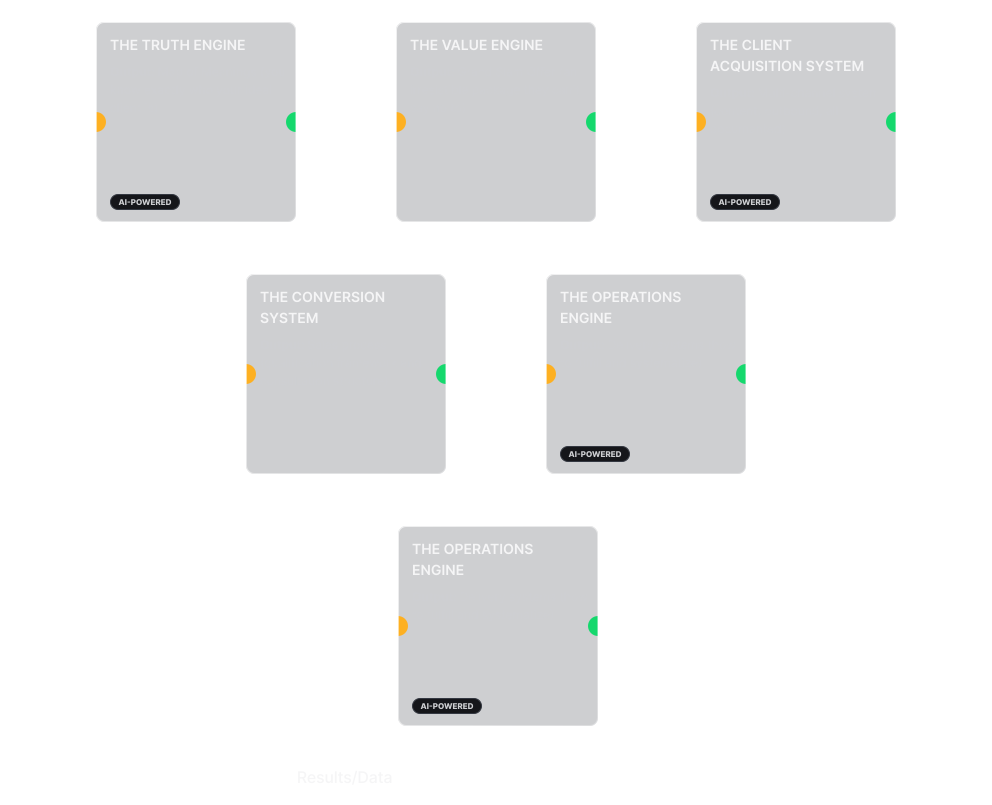
Before we dive in, here's the map to explore
- Hub
System
Why it matters: Because client acquisition breaks when it’s treated as tactics instead of an engine.
Outcome: You understand the components and dependency order of a reliable system.
- Hub
Problems
Why it matters: Because most “marketing issues” are predictable failure patterns with a root constraint.
Outcome: You can diagnose what’s actually breaking your client flow.
- Hub
Comparisons
Why it matters: Because the right approach depends on constraints (time, capital, skill, patience).
Outcome: You can choose a path with tradeoffs visible, instead of guessing.
- Hub
Industries
Why it matters: Because the same system behaves differently under different trust, regulation, and sales cycles.
Outcome: You can adapt the system to your industry’s constraints.
- If you want the blueprint, start with the System.
- If things aren’t working, start with Problems.
- If you’re deciding between approaches, start with Comparisons.
- If you want examples in context, start with Industries.
The problem most people are actually trying to solve
When people say they “need more clients,” they are usually describing symptoms.
- Revenue feels unpredictable.
- Growth stalls or plateaus.
- Work oscillates between overload and drought.
- Every new quarter feels like starting from zero again.
The common response is to add more activity.
More content. More outreach. More experiments.
The underlying problem is rarely effort.
It is the absence of a system that turns effort into predictable outcomes.
This is the difference between motion and progress.
You can explore these patterns in more detail in the section on common client acquisition problems.
What client acquisition actually is
Client acquisition is not a channel.
It is not a campaign.
It is not a growth trick.
Client acquisition is a system that reliably turns attention into qualified conversations, and conversations into revenue.
A real system has:
- clear inputs
- defined outputs
- feedback loops
- constraints that can be diagnosed and improved
Marketing can exist without client acquisition.
Client acquisition cannot exist without a system.
Once you see this distinction, many past failures start to make sense.
When client acquisition is treated as a system rather than a set of activities, its structure becomes visible.
This structure is explained in more detail in the client acquisition system overview.
Why tactics fail without a system
Most tactics fail not because they are useless, but because they are applied in isolation.
- Content without positioning creates noise.
- Outreach without clarity creates resistance.
- Websites without a defined journey create confusion.
Tactics treat symptoms.
Systems address causes.
This is why copying what “worked for someone else” often leads to temporary relief, followed by the same underlying chaos.
The failure is not personal.
It is structural.
This pattern is predictable once you understand why marketing tactics fail without an underlying system.
At its core, this is a first-principles problem, not a best-practices one.
The core components of a client acquisition system
A client acquisition system is built from a small number of dependent components.
While implementations differ, the structure is consistent:
- Understanding the market and the problem being solved
- Designing an offer that resolves that problem clearly
- Transmitting that offer to the right people
- Converting interest into qualified conversations
- Using feedback to refine the system over time
These components must be built in order.
Skipping one creates downstream friction.
This is why many businesses feel busy but fragile.
Who this approach is for, and who it is not
Founders who are tired of building in a vacuum
Agency owners who have hit a ceiling
Freelancers and experts who want stability instead of feast-or-famine cycles
It is not designed for people looking for quick fixes, shortcuts, or growth hacks.
A system takes thought. The payoff is durability.
How people usually go deeper from here
People usually continue from here in different directions.
Some want to understand why their current approach keeps breaking.
Some want to study how a client acquisition system is structured.
Some want to see how this thinking applies to their specific situation.
You can explore each of those paths below.
When people ask for help with this
Some people choose to build their own system once they understand the structure.
Others decide they want help designing and installing it.
If you want to see how I work with clients to design and install these systems, that lives on a separate page.
No urgency. No pressure.